
The Book · 16 September 2026
The Invisible Battle Holding Africa Back
Africa’s hardest battle is not only being fought in its institutions, economies, or borders—it is being fought in the minds of its people. Before we can build a free future, we must first liberate the mind that will build it.
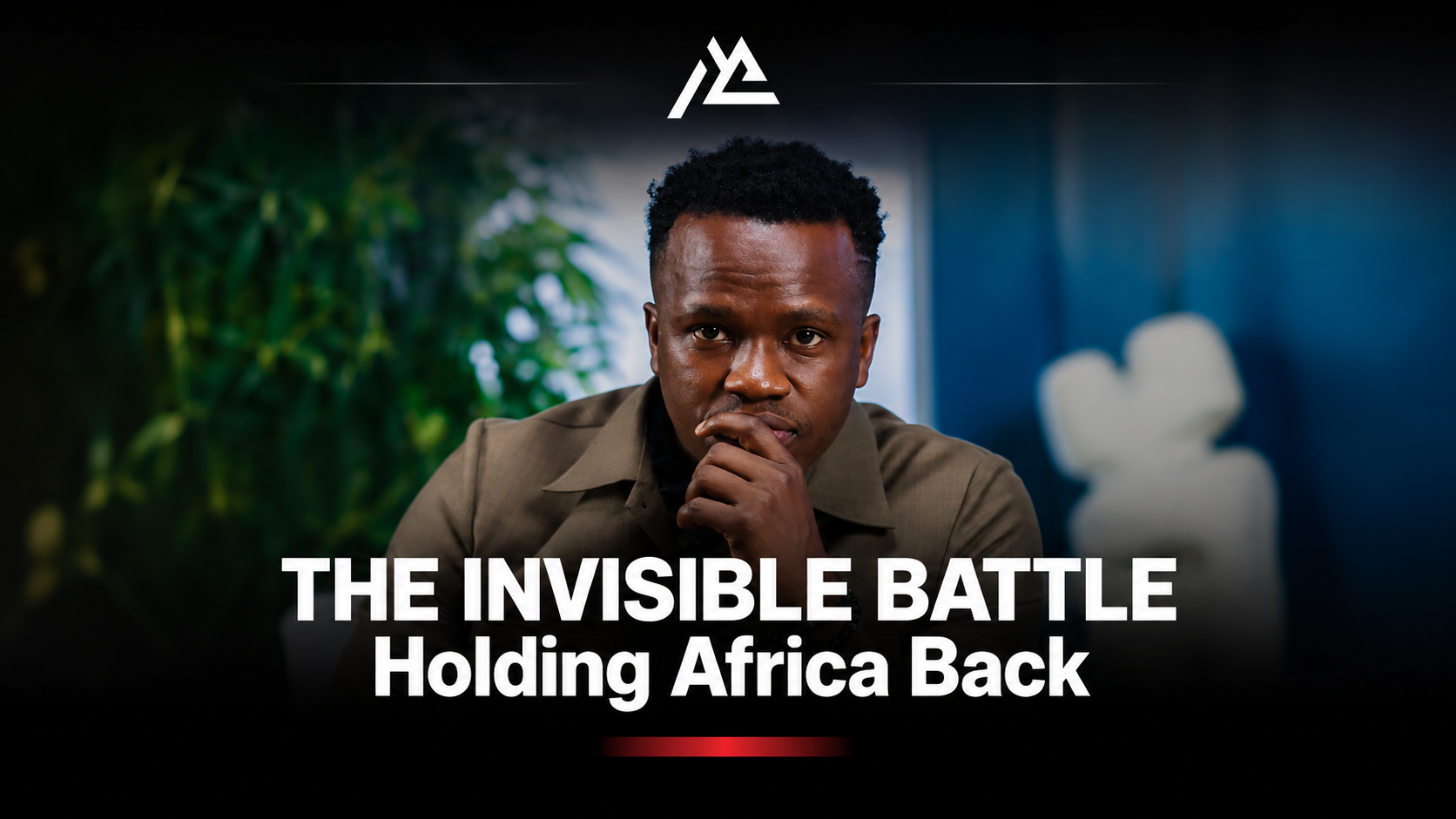
The hardest battles are often the ones nobody sees.
We tend to focus on the battles that are visible: poverty, political instability, conflict, unemployment, weak institutions, inequality, corruption and underdevelopment. We photograph them, debate them, write reports about them and build policies around them.
But what if many of these visible crises are only reflections of a deeper battle taking place somewhere less visible?
Inside the mind.
For decades, Africa has been confronted with questions that seem to have no satisfactory answers. Why does a continent so rich in natural resources remain home to some of the world's poorest populations? Why do political divisions persist long after colonial rule formally ended? Why do Africans sometimes struggle to trust, support or even value one another? Why do so many young Africans dream of leaving rather than transforming the societies they were born into?
And perhaps the most painful question of all:
What is wrong with Africa?
I have spent much of the past decade trying to understand that question.
I travelled across African countries. I produced hundreds of videos. I spoke with entrepreneurs, CEOs, influencers, academics, ordinary citizens and people from different cultural and racial backgrounds. I listened to their experiences and tried to understand the continent not simply through statistics and reports, but through the people who live its reality every day.
I was searching for an answer.
I believed there had to be something beneath the symptoms—something deeper than what appeared on the surface.
For years, I could not identify it.
Then I found the answer in the last place I expected.
Prison.
Not because prison taught me about Africa directly, but because it forced me to confront myself.
Away from the noise, distractions and demands of ordinary life, I had an unusual opportunity to become still. I began examining the contents of my own mind—my assumptions, fears, beliefs, ambitions, identity and understanding of freedom.
And that is where a different question emerged.
Perhaps the most important question for Africa is not simply, How do we change our circumstances?
Perhaps it is:
How do we change the way we think about ourselves and our possibilities?
That question became the foundation of my book, A Free Mind Builds a Free Future.
The freedom I began writing about was not primarily physical freedom. It was intellectual freedom—the freedom to think, question, imagine and define one's future without being imprisoned by inherited assumptions.
Because physical freedom means little when the mind remains captive.
A person can walk freely and still live inside invisible boundaries created by fear, inferiority, dependency or limiting beliefs. Conversely, even when physical circumstances are restrictive, a person whose mind remains free can preserve the capacity to imagine another reality.
This led me to a conviction that has increasingly shaped my understanding of Africa:
The struggle for Africa's future is, in large part, a struggle over the African mind.
This is not an argument that poverty, poor governance, inadequate infrastructure, historical exploitation or institutional weakness are imaginary. They are real, measurable and consequential. Africa's challenges cannot responsibly be reduced to psychology.
But institutions are built by people.
Economies are built by people.
Governments are led by people.
Communities are shaped by people.
And before people build systems, they build ideas.
Ideas determine what societies consider possible, valuable and worth pursuing.
If education is not valued, investment in education suffers. If entrepreneurship is seen as impossible, people rarely attempt it. If citizens believe their country cannot prosper, they stop imagining prosperity as something they can create. If Africans internalize the idea that what comes from elsewhere is automatically superior, local knowledge, products and institutions struggle to gain confidence.
The external world is often shaped by the internal world.
This is why I believe the conversation about Africa must go deeper.
For generations, we have asked how Africa can develop. We have discussed foreign investment, aid, infrastructure, technology, trade, debt, governance and industrialization.
All of these matter.
But we must also ask what kind of mind is required to build the Africa we say we want.
A continent cannot become psychologically dependent and economically independent at the same time.
A people cannot continually believe that excellence belongs somewhere else and then expect to build institutions capable of competing globally.
A generation cannot be taught to admire everything foreign while being ashamed of its own identity and expect cultural confidence to emerge naturally.
This is where the unfinished work of decolonization becomes important.
Decolonization cannot simply mean changing political structures or removing colonial symbols. It must also involve examining the ideas that survived colonialism.
What did we learn to believe about ourselves?
What did we learn to believe about our languages?
Our cultures?
Our appearance?
Our history?
Our intellectual capacity?
Our institutions?
Our ability to govern ourselves?
Our ability to create?
These questions are not about rejecting everything foreign or romanticizing everything African. That would simply replace one form of intellectual captivity with another.
The goal is freedom.
The freedom to evaluate ideas without automatically assuming that they are superior because they originated elsewhere.
The freedom to embrace what is valuable from the world without abandoning what is valuable within ourselves.
The freedom to learn from others without becoming copies of others.
The freedom to look at Africa not only as a continent that needs solutions, but as a continent capable of producing them.
One of the most disturbing consequences of psychological colonization is that it can eventually become self-sustaining.
The oppressor no longer needs to tell you that you are inferior if you have learned to tell yourself.
You no longer need someone to diminish your culture if you have learned to diminish it yourself.
You no longer need someone to divide you if you have accepted the divisions as permanent.
This is perhaps one of the most difficult battles Africa faces.
Not the battle over minerals.
Not merely the battle over territory.
Not even the battle over political power.
The battle over the African imagination.
Consider how Africa is represented in the global imagination. Search the internet for Africa and the images and narratives that frequently dominate the conversation: poverty, war, famine, disease, corruption, migration and crisis.
These realities exist. Denying them would be dishonest.
But they are not the whole story.
Africa is also creativity, entrepreneurship, music, technology, intellectual traditions, innovation, resilience, culture, languages, young people and extraordinary human potential.
The danger is not simply that the world may misunderstand Africa.
The greater danger is that Africans may eventually begin to see themselves through the same distorted lens.
When a people repeatedly encounter narratives that portray them as incapable, dependent or perpetually behind, those narratives can eventually influence how that people see themselves.
And once a limiting narrative becomes internalized, it becomes much harder to defeat.
This is why the battle for Africa's future must include a battle for the narrative of Africa.
But changing the narrative is not about creating propaganda or pretending that our problems do not exist.
It is about telling the complete story.
It is about replacing inherited inferiority with honest self-knowledge.
It is about teaching African children that their continent has a history before colonialism, that their ancestors created civilizations, institutions, intellectual traditions and cultures worth studying, and that their future does not have to be defined by the limitations of their present.
It is about restoring the ability to imagine.
Because before a nation builds something, somebody has to imagine it.
Before Africa becomes united, Africans must first be able to imagine themselves as one people with shared interests.
Before borders become less restrictive, we must first challenge the mental borders that prevent Africans from seeing one another as partners.
Before Africa can become economically powerful, Africans must believe that African problems can be solved by African creativity, African capital and African institutions working with the rest of the world on equal terms.
The transformation of Africa therefore cannot begin only in parliament, in boardrooms or in development conferences.
It must also begin in the mind.
This is why I wrote A Free Mind Builds a Free Future.
I did not write it because I believe I have solved Africa's problems. I have not.
I wrote it because I believe we have spent too much time treating symptoms without sufficiently examining the ideas beneath them.
The book is my attempt to start a deeper conversation about intellectual freedom, identity, knowledge and the power of the mind to shape the future.
I believe the first step toward transformation is recognition.
You cannot confront a problem you refuse to see.
And once you see it, you must have the courage to confront it.
Africa still has a long road ahead. There are structural problems that require serious political, economic and institutional solutions. There are historical injustices that cannot simply be forgotten. There are contemporary failures that must be confronted honestly.
But beneath all these challenges is a generation that must decide what it believes about itself.
That may ultimately determine everything else.
The future of Africa will not be built only with roads, factories, technology or capital.
It will be built with minds.
And if those minds remain imprisoned by inherited limitations, no amount of physical development will be enough.
But if Africans become intellectually free—free to think, free to question, free to create, free to unite, free to value themselves and free to imagine a future beyond the boundaries imposed upon them—then something fundamental changes.
Africa does not become free merely when its circumstances change.
Africa becomes free when Africans become free in their minds.
The hardest battle has always been the one nobody sees.
And perhaps Africa's greatest battle is being fought right now—not beneath the soil, not across borders, and not only inside political institutions.
It is being fought inside the minds of Africans.
That is the battlefield.
And that is where the transformation must begin.
I deliberately framed the argument so it doesn't claim that mindset alone causes Africa's problems—that would be easy for an international editor to dismiss. Instead, the argument is that institutions, economies, identity and political systems are ultimately shaped by human beings and therefore by ideas. That makes the thesis much more defensible and publication-ready.
Grab my book now "A Free Mind Builds A Free Future" to dive deep on this topic
By Mika Chavala


Comments
Join the conversation. You can comment anonymously.
Loading comments…