
Article · 9 August 2026
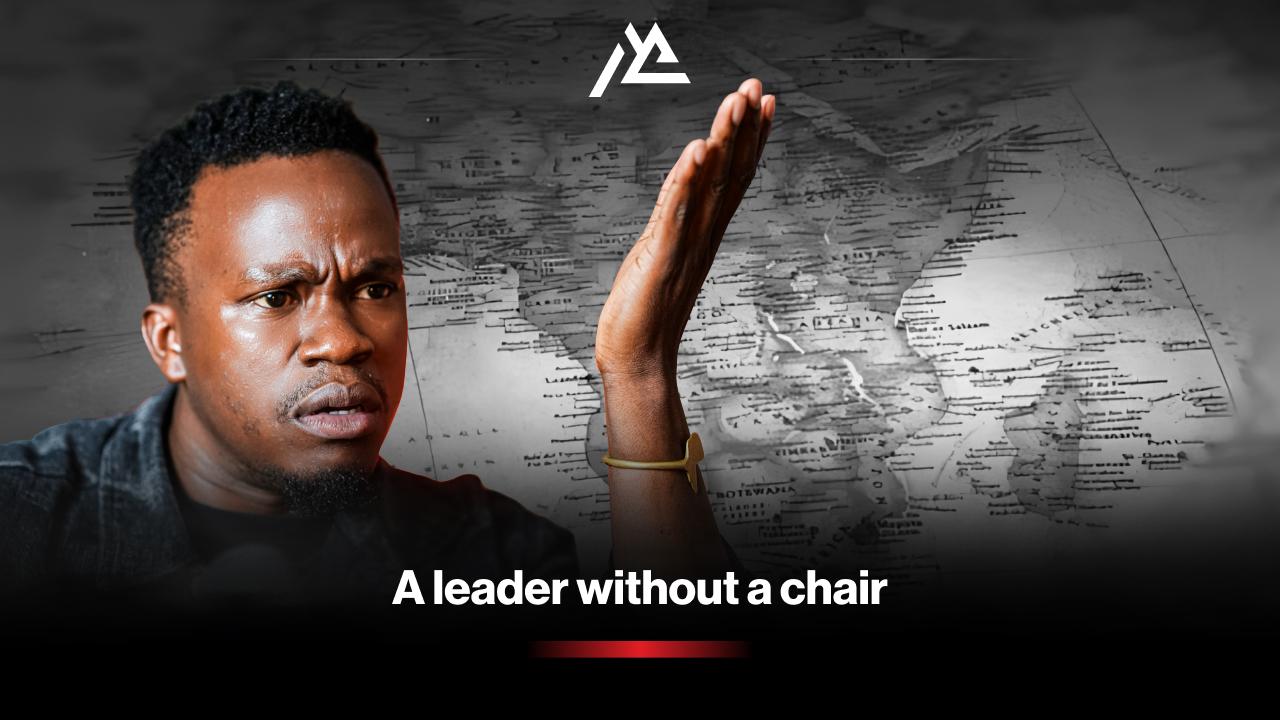
A Leader Without a Chair
Africa does not lack leaders; it lacks a deeper understanding of what leadership truly means. Too often, leadership has become associated with chairs, titles, convoys, wealth, prestige, and power, while the true essence of leadership—service, sacrifice, integrity, accountability, and influence—is forgotten. A leader is not defined by the position they occupy, but by the responsibility they are willing to carry for others. This article challenges Africa to rethink its leadership culture and asks a fundamental question: If you remove the chair, the title, the convoy, and the applause, will people still follow you?
Rethinking Leadership, Power and Africa’s Future
One of the greatest challenges facing Africa today may not be a lack of resources, talent, or potential. It may be the way Africans have come to understand leadership. Across the continent, leadership is often associated with political office, wealth, prestige, expensive vehicles, security escorts, large houses, public recognition, and the authority to command others. But what happens when leadership is separated from service, sacrifice, integrity, and accountability?
This is the question at the heart of a powerful conversation about the future of African leadership. The central argument is simple: leadership is not about having a chair; it is about having a responsibility.
A person does not become a leader merely because they occupy an office, receive a title, travel with a convoy, wear an expensive suit, or receive applause from crowds. These things may accompany leadership, but they do not define it. True leadership is measured by the willingness of an individual to carry the burdens of the people they represent and to put the interests of others above personal comfort and privilege.
The Problem With the Image of Leadership
One of the biggest problems in Africa is that leadership has increasingly been presented as a pathway to personal success rather than an opportunity for public service. Many people look at political leaders and see the privileges that come with their positions. They see expensive cars, large homes, security details, public recognition, and access to resources. As a result, leadership itself can become something people pursue because of what they believe they will receive from it.
When leadership becomes attractive because of its privileges rather than its responsibilities, society begins to attract people who want the position but do not necessarily want the sacrifice that comes with it.
This creates a dangerous misunderstanding. Leadership is not about being better than everyone else. It is not about being treated as more important than ordinary citizens. It is not about having people move out of your way because you are travelling in a convoy. It is not about receiving a large salary while the people you represent struggle to afford food, education, healthcare, or basic necessities
Leadership should instead be understood as a responsibility entrusted to an individual by other people.
Leadership Is Sacrifice
True leadership requires sacrifice because a leader is entrusted with the interests, hopes, and future of other people. When millions of citizens place their confidence in an individual, that person is no longer living only for themselves. Their decisions affect the lives of people they may never personally meet.
This is why one of the most important questions anyone seeking leadership should ask is not, “What will I gain from this position?” but rather, “What am I willing to sacrifice for the people I want to lead?”
A leader should be willing to put their reputation, comfort, time, resources, and even personal interests aside when the wellbeing of the people demands it. Leadership becomes meaningful when the leader is willing to carry a burden that others cannot carry.
The true spirit of leadership is therefore closer to servanthood than privilege.
“Leadership Is Slavery”
The statement that “leadership is slavery” may sound extreme, but it expresses an important principle when understood as voluntary service. A leader is, in a sense, a servant of the people because the authority they possess is entrusted to them by others.
A leader does not appoint themselves simply because they believe they are better than everyone else. People give leaders responsibility because they believe those individuals can provide direction, solve problems, protect interests, and create a better future.
The leader must therefore listen to the people, understand their needs, combine their concerns with knowledge and creativity, and then provide direction.
Leadership is not simply about telling people what to do. It is about having a vision and demonstrating a path that others can confidently follow.
Leadership Is Influence
At its deepest level, leadership is influence. A person may have authority without having genuine influence, but genuine leadership requires people to willingly follow.
Imagine a room where ten people are sitting together. If one person stands up and walks out, and several others naturally decide to follow that person without being ordered to do so, there is something about that individual that has created influence.
That influence may come from character, trust, vision, competence, integrity, or relationships.
A leader does not always need to say, “Follow me.” Sometimes people follow because they have seen enough in the person’s character and vision to trust where they are going.
This is the kind of leadership Africa needs to cultivate.
Africa’s Leadership Crisis
The leadership crisis in Africa is not simply about individual politicians. It is also about the systems that determine how leadership operates.
When leaders are not held accountable, when institutions are weak, when corruption becomes normalized, and when citizens lose confidence in political processes, the entire society suffers.
One of the most troubling consequences is political apathy. When citizens begin to believe that their votes do not matter or that political outcomes are predetermined by forces beyond their control, they may stop participating altogether.
That creates a dangerous environment because democracy cannot function effectively when citizens lose faith in their ability to influence their own government.
Leadership must therefore be accompanied by accountability. Leaders must understand that public office is not personal property. It is a temporary responsibility entrusted to them by citizens.
Colonialism and the African Leadership System
Another major argument raised in the discussion is that Africa may have achieved political independence without completely dismantling some of the systems and structures inherited from colonial rule.
The problem is not simply who occupies the position of power. The deeper question is how the system itself operates.
If a system is designed around control rather than service, a good person entering that system may eventually find themselves adapting to its weaknesses. Even someone who begins with good intentions can become compromised when the incentives around them reward corruption, loyalty, silence, and personal benefit.
This is why changing leaders alone may not be enough.
Africa must also reform the systems that produce and protect poor leadership.
A good leader inside a corrupt system can be pressured to compromise. A strong leader may resist for a while, but if the institutions around them remain dysfunctional, the system can eventually absorb them.
Therefore, Africa needs both better leaders and better institutions.
Accountability Must Become a Culture
One of the defining qualities of a good leader is accountability. A leader should be willing to accept responsibility not only when things succeed but also when things fail.
It is easy to take credit when a project succeeds. It is much more difficult to stand before the public and say, “I was responsible, and I failed.”
Yet that willingness is essential to healthy leadership.
In several countries around the world, senior officials have resigned after serious failures because they believed that accepting responsibility was part of their duty. Resignation is not necessarily an admission that someone is useless; sometimes it is an expression of accountability.
Africa needs to develop a culture where stepping aside after failure is not automatically interpreted as weakness. Sometimes the most responsible thing a leader can do is acknowledge that someone else may be better positioned to take the country, institution, or organization forward.
The Everyday Culture of Corruption
Leadership cannot be separated from the culture of corruption that exists within society.
Corruption is often discussed as though it only involves presidents, ministers, or senior government officials. In reality, corruption can begin with ordinary everyday decisions.
A small bribe at a border crossing may appear insignificant. A payment made to avoid a procedure may seem harmless. A personal favor exchanged for an official service may appear normal.
However, every small compromise contributes to a culture in which people begin to believe that rules are negotiable and that public servants should be paid privately to perform duties for which they are already receiving a salary.
A powerful example comes from the experience of refusing to pay bribes at the Zambia–Tanzania border. Despite the inconvenience and the many hours spent waiting, the decision was made not to participate in corruption.
The principle was straightforward: if an official is being paid to perform a public duty and the citizen has done nothing wrong, why should the citizen have to pay additional money simply to receive that service?
Refusing corruption may sometimes be inconvenient, but accepting it creates a precedent. If a person pays today, they may be expected to pay tomorrow. Eventually, an entire generation can grow up believing that corruption is simply part of life.
That is how societies compromise their integrity.
Africa’s Three Enemies
The discussion also presents a modern interpretation of the challenges identified by Mwalimu Julius Nyerere, who famously spoke about ignorance, poverty, and disease as major enemies of Africa.
The argument presented in the conversation is that Africa must now confront three major enemies: mindset, leadership, and exploitation.
The first is mindset.
Africa’s problems are real, but the way Africans think about those problems also matters. If people constantly define Africa as poor, incapable, dependent, and permanently behind the rest of the world, that mindset can become a psychological barrier to development.
Africa is not without resources. The continent possesses enormous natural resources, a young population, cultural diversity, intellectual talent, agricultural potential, and significant economic opportunities.
The question is therefore not simply whether Africa has resources. The question is whether Africans have developed the mindset, institutions, and leadership necessary to transform those resources into prosperity.
The second enemy is leadership.
When leaders repeatedly make promises but fail to deliver, when accountability is weak, and when political office becomes a pathway to personal enrichment, leadership itself becomes an obstacle to development.
The third enemy is exploitation.
Exploitation does not belong to one race or nationality. Africans can exploit Africans, just as foreigners can exploit Africans. Anyone who uses power, wealth, influence, or opportunity to abuse vulnerable people contributes to the problem.
The fundamental issue is not the color of the exploiter. It is the behavior.
Education Must Teach People How to Think
The conversation also challenges the traditional reliance on examinations as the primary method of evaluating students.
The argument is not that students should never be assessed. Rather, the concern is that a person’s ability cannot always be accurately measured by their performance in a limited examination lasting one or two hours.
A student may spend several years studying a subject and then be judged largely by their performance on a small number of questions. Someone with excellent memory may perform extremely well, while another person who understands the subject deeply but struggles with memorization may perform poorly.
This raises an important question: Are we measuring intelligence, or are we measuring the ability to pass an examination?
Alternative forms of assessment could include research, projects, presentations, discussions, and practical applications of knowledge.
Research teaches students how to investigate problems and search for evidence. Presentations teach communication and confidence. Projects teach students how to apply knowledge to real-world situations. Debate teaches people how to build and defend arguments.
These skills are especially important in leadership.
Africa Must Learn to Compete With Arguments
A healthy society should be able to disagree without becoming enemies.
If someone challenges your idea, you should be able to respond with evidence. If someone disagrees with your position, you should be able to present a stronger argument. If someone has a different perspective, you should be able to sit around a table and debate the issue.
Africa cannot develop a culture of intellectual competition if disagreement is treated as disrespect or opposition. The goal should not be to silence the person with whom we disagree. The goal should be to build a better argument.
Africa must learn to compete with the power of ideas rather than the power of intimidation.
A New Generation of African Leaders
The future of Africa will depend heavily on the kind of leaders the continent produces over the coming decades.
Young Africans must be taught that leadership is not a shortcut to wealth. It is not a privilege reserved for the most powerful. It is not about being served by the people.
Leadership is about serving people.
Young people must also understand that having the ability to speak well, attract followers, build a large audience, or become popular does not automatically make someone a good leader.
Leadership requires character.
It requires integrity.
It requires vision.
It requires discipline.
It requires accountability.
And above all, it requires the willingness to sacrifice.
A Leader Without a Chair
Perhaps the most important question we can ask is this: If you remove the chair, the title, the convoy, the salary, the security detail, and the applause, will people still follow you?
If the answer is yes, then you may possess something more powerful than a position.
You possess influence.
A chair can give you authority, but it cannot give you character. A title can give you recognition, but it cannot give you integrity. Money can give you comfort, but it cannot give you legitimacy. Power can make people obey you, but it cannot make them genuinely believe in you.
The greatest leaders are not necessarily those sitting in the biggest chairs.
They are the people who can influence others even when there is no chair, no title, no microphone, and no audience.
Africa does not simply need more people occupying leadership positions. It needs a new generation of people who understand what those positions are supposed to represent.
The chair should never be the reward for leadership.
The chair should be the responsibility that comes with it.
And perhaps the ultimate test of leadership is not how many people stand when you enter a room, but how many people are willing to walk with you when there is nothing to gain.
That is the difference between occupying a position and becoming a leader.
A leader without a chair. 🪑

Comments
Join the conversation. You can comment anonymously.
Loading comments…