
Article · 10 August 2026
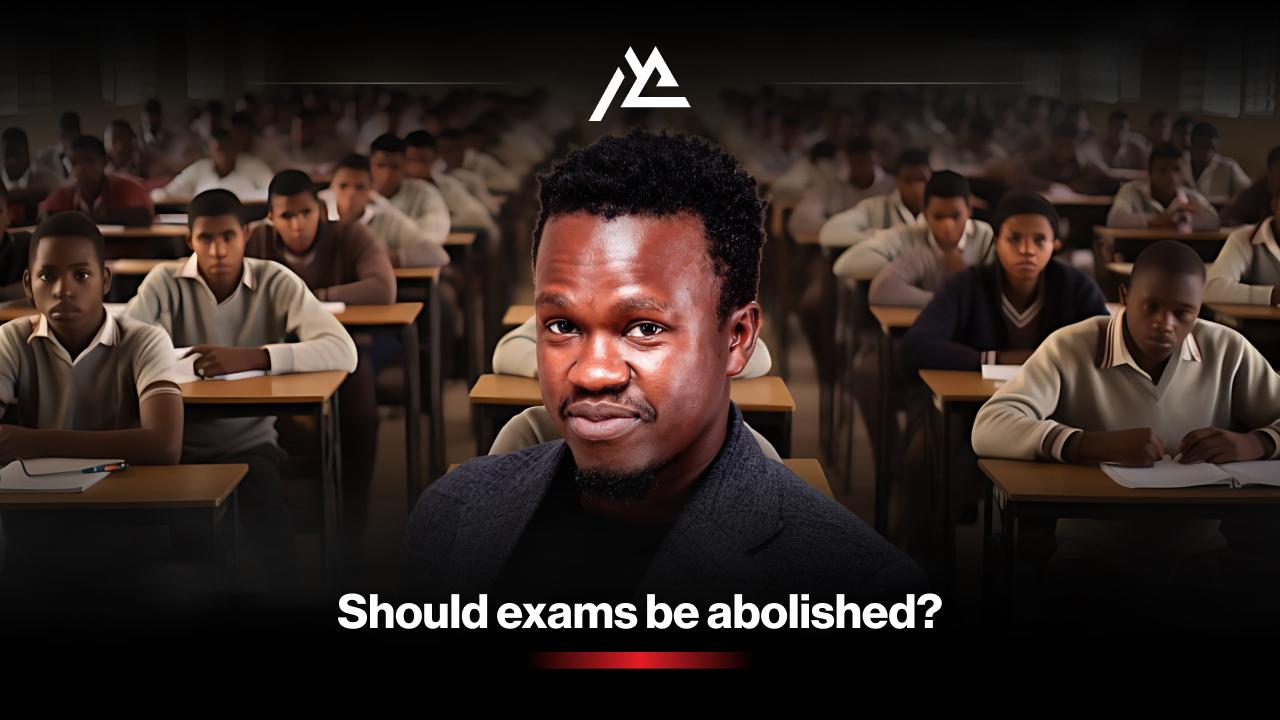
SHOULD EXAMS BE ABOLISHED?
Can a two-hour examination truly measure what a student has learned over four years? Exams often reward memorization rather than deep understanding. A student may understand a subject but fail because they struggle to memorize information or perform under examination pressure. Education should therefore move beyond traditional exams and embrace research, projects, presentations, practical assignments and critical thinking. These methods help students develop the ability to analyze problems, build arguments, communicate ideas and create solutions. Africa does not simply need students who can pass examinations. We need thinkers, innovators, problem-solvers and leaders who can use knowledge to transform society. The future belongs not to those who merely remember what they were taught, but to those who learn how to think.
REIMAGINING HOW AFRICA EDUCATES ITS CHILDREN
For generations, education systems across Africa have treated examinations as one of the primary measures of intelligence, academic achievement, and future potential. From primary school to university, students are often judged according to the marks they receive in examinations. High marks are associated with intelligence and success, while low marks can sometimes determine how society, institutions, and even students themselves perceive their potential.
But what if we have been measuring only one part of human intelligence?
What if the question is not whether examinations are important, but whether a single examination should have the power to define years of learning, effort, creativity, and potential?
A powerful argument is emerging in conversations about education reform: Can a two-hour examination truly measure four years of learning?
The argument is simple. A student may spend years attending classes, completing assignments, reading books, conducting research, developing ideas, and gaining practical knowledge. Yet, in many education systems, much of that experience can ultimately be reduced to a few questions answered within a limited period of time and under intense pressure.
The result of that examination may then determine whether the student is considered successful or unsuccessful.
However, a high examination score does not always mean that a student has developed a deep understanding of a subject. One student may perform exceptionally well because they have an excellent ability to memorize information. Another student may understand a concept deeply, think creatively, and be capable of applying knowledge to real-life situations, yet struggle to reproduce information under the pressure and conditions of a formal examination.
This does not mean that assessment is unnecessary.
It means that the way we assess learning deserves to be reconsidered.
FROM MEMORIZATION TO UNDERSTANDING
The purpose of education should be greater than teaching students how to remember information long enough to reproduce it in an examination hall. True education should develop understanding, curiosity, creativity, reasoning, and the ability to apply knowledge to real-world situations.
The important question should therefore not simply be:
“How much can you remember?”
It should also be:
“What do you understand?”
“What can you create?”
“What problems can you solve?”
“Can you explain your ideas?”
“Can you apply what you have learned?”
“Can you contribute something meaningful to society?”
A modern education system should recognize that intelligence cannot always be measured through one method. Human beings have different abilities, different ways of learning, and different strengths. Some students excel in writing examinations, while others excel in research, innovation, communication, leadership, technology, practical work, or creative problem-solving.
If education measures only the ability to answer examination questions, it may fail to recognize many other forms of intelligence and potential.
Africa must therefore begin to think about a broader and more balanced model of assessment.
RESEARCH INSTEAD OF ROTE LEARNING
Imagine a university where students do not spend the entire semester simply preparing for a final examination.
Instead, they are given real problems to investigate.
A student studying agriculture could research how to improve food production in a particular region.
A student studying engineering could investigate a local infrastructure challenge and develop a possible solution.
A journalism student could conduct an in-depth investigation into an issue affecting their community.
A student studying economics could analyze unemployment, inflation, or entrepreneurship and propose practical recommendations.
The students would not simply memorize theories.
They would research.
They would collect evidence.
They would interview people.
They would analyze data.
They would identify causes.
They would compare different ideas.
They would develop possible solutions.
And finally, they would present and defend their findings before professors, experts, and fellow students.
Suddenly, education would become more than preparation for an examination.
It would become preparation for life.
Research develops analytical thinking. It teaches students how to ask meaningful questions, search for evidence, distinguish facts from opinions, and reach conclusions based on information.
Presentation develops communication skills and confidence. Defending an argument develops reasoning and intellectual discipline. Working on real-world problems develops creativity, innovation, and problem-solving.
These are the abilities that students will need long after they have left the classroom.
THE POWER OF PRESENTATION AND ARGUMENT
A student who can stand before an audience and clearly explain an idea has developed an important skill that cannot always be captured through a written examination.
Can the student construct a logical argument?
Can they defend their position when challenged?
Can they respond intelligently to criticism?
Can they communicate complex ideas in a simple and understandable way?
Can they think under pressure?
Can they persuade others using evidence, logic, and facts rather than simply relying on authority?
These abilities are essential in almost every field.
They matter in business.
They matter in science.
They matter in politics.
They matter in journalism.
They matter in technology.
They matter in law.
They matter in leadership.
Africa needs young people who are not only capable of knowing something but are also capable of explaining what they know, defending their ideas, listening to opposing arguments, and changing their views when presented with stronger evidence.
Education should therefore create classrooms where students are encouraged to think, question, discuss, disagree respectfully, and defend their ideas.
A student should not graduate from a university with knowledge alone.
They should graduate with the confidence to use that knowledge.
BUT SHOULD ALL EXAMINATIONS DISAPPEAR?
The debate becomes more nuanced at this point.
Examinations are not inherently useless. Written and standardized assessments can provide important information about what students have learned. They can help teachers and institutions identify learning gaps and compare academic performance against established standards.
The problem is not necessarily the existence of examinations.
The problem is the overdependence on high-stakes examinations.
When an education system places too much importance on one final examination, students may begin to learn primarily for the purpose of passing the test rather than understanding the subject.
Teachers may feel pressure to focus only on topics that are likely to appear in examinations. Students may memorize information without developing the ability to apply it. Creativity and curiosity may gradually disappear because students become afraid of giving the wrong answer.
Education can then become a competition of memory rather than a journey of discovery.
The solution, therefore, may not be to abolish every examination tomorrow.
The solution may be much simpler:
STOP USING ONE EXAMINATION TO DEFINE A STUDENT.
A modern assessment system could combine different methods to create a more complete picture of a student's abilities and potential.
For example, student performance could be evaluated through:
- 📝 Written examinations that test academic understanding.
- 🔬 Research projects that develop investigation and analysis.
- 🎤 Presentations that build communication and confidence.
- 🧩 Problem-solving tasks that test the ability to apply knowledge.
- 💼 Practical projects that connect learning with real-life situations.
- 📚 Portfolios that demonstrate progress and long-term development.
- 🤝 Teamwork that develops collaboration and leadership.
- 💡 Innovation and creativity that encourage new ideas and solutions.
- 🗣️ Public speaking and argumentation that strengthen reasoning and communication.
Such a system would not eliminate academic standards.
Instead, it would create a more balanced understanding of intelligence.
A student who performs poorly in a written examination might demonstrate exceptional ability through research or practical work. Another student might be an outstanding communicator and leader. Another might possess extraordinary creativity and innovation.
Education should have the ability to recognize these differences.
AFRICA NEEDS A NEW EDUCATIONAL PHILOSOPHY
Perhaps the deeper issue is not examinations themselves.
Perhaps the deeper question is this:
What kind of human being is our education system designed to produce?
If our education system produces students who can memorize answers but cannot solve problems, question assumptions, conduct research, communicate ideas, work collaboratively, or defend an argument, then we must ask whether the system is truly preparing young Africans for the future.
Are we educating young people to pass the next examination?
Or are we educating them to face the challenges of life?
Africa does not simply need more graduates.
Africa needs thinkers.
Africa needs researchers.
Africa needs innovators.
Africa needs builders.
Africa needs entrepreneurs.
Africa needs scientists.
Africa needs communicators.
Africa needs leaders.
Africa needs problem-solvers.
The continent faces enormous challenges, but challenges cannot be solved by memorization alone.
They require people who can think differently.
People who can ask difficult questions.
People who can investigate problems.
People who can analyze evidence.
People who can develop practical solutions.
People who are not afraid to challenge outdated assumptions.
And above all, Africa needs a generation of young people who can sit around a table and compete with the power of ideas and arguments—not the power of position, money, or authority.
That is the kind of intellectual culture education should help to build.
THE QUESTION FOR AFRICA
What if the ultimate measure of education was not simply:
“How many marks did you get?”
But rather:
“What can you do with what you have learned?”
Can you solve a problem?
Can you create something new?
Can you lead a team?
Can you conduct meaningful research?
Can you communicate an idea?
Can you build a business?
Can you develop a solution for your community?
Can you use your knowledge to improve the lives of others?
These questions may be closer to the true purpose of education.
The educational revolution Africa needs may not begin with the complete abolition of examinations. It may begin with changing the philosophy behind education itself.
We must move from an education system that primarily asks students to remember toward one that also challenges them to think, question, create, investigate, communicate, and solve problems.
The goal of education should not simply be to produce students who can pass examinations.
It should be to produce individuals who can face the realities of life with knowledge, confidence, creativity, character, and courage.
Because the future of Africa will not be built only by those who remember what they were taught.
It will be built by those who learned how to think, how to question, how to create, and how to transform knowledge into solutions.
And perhaps that is the most important examination of all:
Not whether a student can pass a test in the classroom, but whether they can use what they have learned to help transform the world outside it.


Comments
Join the conversation. You can comment anonymously.
Loading comments…